
Mental Health First Aiders in the workplace are trained to notice, listen and signpost. But who looks after them when the conversations they’re having are tough?
MHFA England and the Association of Mental Health First Aiders published the first ever Workplace Mental Health First Aid Standards in October 2026. For the first time, there’s a clear national benchmark for what good MHFA provision looks like.
And one of the things it makes non-negotiable is support for MHFAiders themselves.
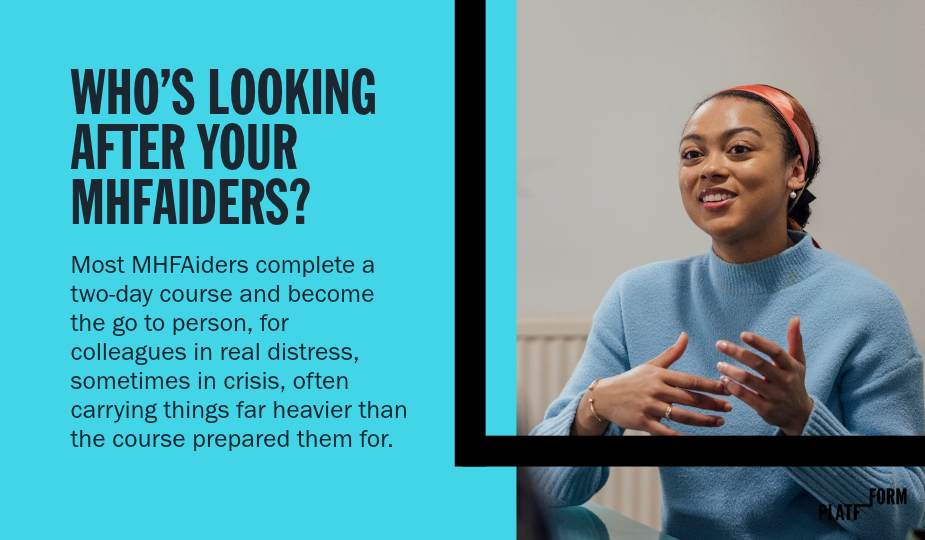
It’s a welcome step. Most MHFAiders complete a two-day course and become the go to person, for colleagues in real distress, sometimes in crisis, often carrying things far heavier than the course prepared them for. Being that person for someone matters, but some crisis situations may leave people dealing with issues they weren’t fully ready for.
Put simply, who’s looking after them?
What are Mental Health First Aiders trained to do?
MHFA training is designed to build mental health awareness. It teaches people to recognise signs that someone is struggling, start an open conversation, and point someone towards further support.
In practice, the conversations MHFAiders are having don’t always stay within that frame.
And they’re not occasional. According to the new standards, On average, someone reaches out to an MHFAider two to three times a week. That’s very different from physical first aid, where a first aider might go months without being called on.
Research from the University of Manchester found that stress was the single biggest reason colleagues sought out a MHFAider, followed closely by workplace events and bullying or harassment. These are real and often unresolved situations, and they can be heavy to hear.
MHFAiders are caring roles and they go further than initial support and signposting. They are often holding sensitive, confidential and distressing information. That’s a lot to carry, especially alongside a day job.
The next step: looking after your MHFAiders
Research by the University of Nottingham, found real value in the awareness MHFA builds.
MHFA gives people the confidence to start a conversation. The next step is making sure the person who had that conversation is looked after too.
Do they have a safe space to talk about what they are experiencing?
What do the new standards say about supporting MHFAiders?
A whole standard is dedicated to the support and wellbeing of MHFAiders. It acknowledges that MHFAiders share in other people’s emotional burdens, and warns that without active support, organisations risk:
“burning out the very people their colleagues rely on.”
Under the standards, employers are now required to:
- Provide regular peer support and debrief sessions, with a structured check-in as the minimum
- Hold regular wellbeing check-ins with each MHFAider, to spot signs of fatigue or emotional overload early
- Let MHFAiders pause or step down from the role at any time, without penalty or pressure
- Give protected time within working hours for debriefs and peer support
- Provide a written role description that sets out the boundaries of the role and the support available to MHFAiders themselves
The standards recommend individual follow-up support after particularly difficult situations, and encourage MHFAiders to use occupational health and Employee Assistance Programmes when the role feels demanding, keeping them safe.
We believe this should be done regularly; what’s difficult for one person may be different to another, and sometimes can take a while to impact.
Why does supporting mental health first aiders in the workplace matter so much?
Anyone supporting people through distress, trauma or complexity can absorb some of that weight themselves.
We see this clearly in our work with frontline and caring professions. As Platfform Associate Psychologist Sarah Brown explains:
“When the work is heavy and when we are working alongside trauma, injustice and complexity a lot of the time, that inevitably has an impact on us.”
At Platfform, we take a relational, trauma-informed approach to mental health.
Rather than asking “what’s wrong with you?”, we ask “what’s happened to you?”
Our circumstances, the things that are happening to us and the things that aren’t, have a greater influence on our mental health than anything else.
There’s a lot going on in the world: increased division, cost of living, uncertainty and pressure at work. This means colleagues may bring more to MHFAiders.
Hearing those stories, without time to reflect, can mean it’s easy to take them home. What helps is the same thing that helps anyone in a supporting role: feeling psychologically safe and knowing they have support around them too.
This is exactly why supervision and reflective practice are considered essential, not optional, in counselling, mental health nursing and other helping roles. Listening to distress takes its toll, and it needs somewhere to go.
Is a manager check-in enough?
A check-in can be useful. But only if your employee feels completely safe to be honest. Whether they feel safe depends on culture and your workplace relationship. People who worry it will reflect badly on them may hold things in.
With hybrid and remote working, managers don’t see colleagues every day, so the signs someone isn’t coping are easier to miss.
That’s where reflective practice and supervision can be a useful space outside line management.
Reflective practice: giving MHFAiders somewhere to process what they hear
Reflective practice can be a valuable part of how the role is held.
What exactly is reflective practice? It gives people the opportunity to pause and move away from feeling overwhelmed: that might mean unpacking a conversation that’s stayed with them, an opportunity to offload in complete confidence or to process emotional responses.
Platfform Operations lead Phil Richardson speaks to why this matters for anyone in a support-facing role:
“Supervision helps me make sense of my feelings and helps me process stuff, and that’s really, really important for me.”
Not creating a reflective space can also mean:
- Increased burnout
- Reduced trust
- Higher turnover
- Surface-level conflict
People can’t keep holding complexity without somewhere to put it down, even briefly.
This isn’t about MHFAiders needing to be more resilient
It’s tempting to frame this as an individual issue. Give MHFAiders better self-care tips, tell them to set boundaries, and move on.
But that misses the point. As Dr Rachel Sumner has said of burnout more broadly:
“Burnout isn’t a failure of the individual. It’s a failure of the system to protect them.”
Organisations need to have thought about what the role actually involves, and built in the support to match it.
What does employer support look like?
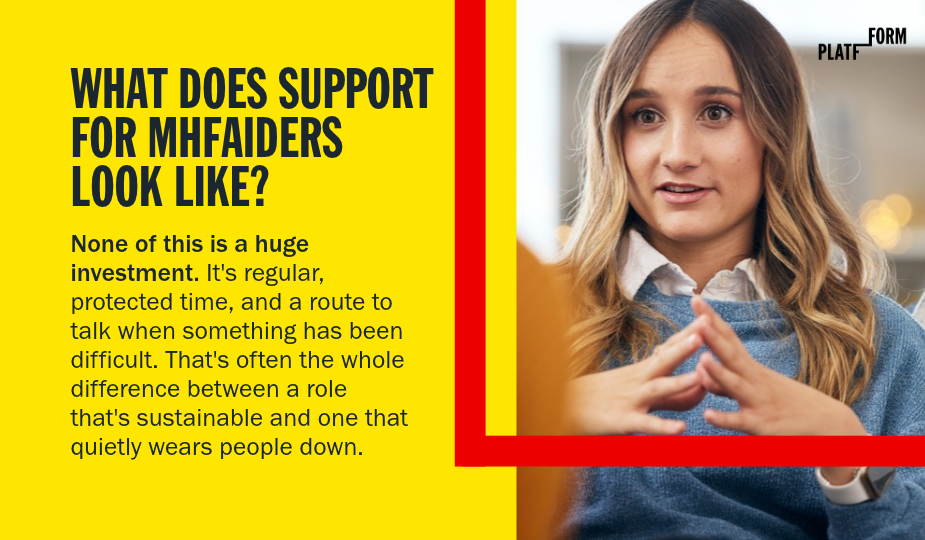
You don’t need to overhaul your whole approach to start closing this gap and it doesn’t need to be complicated. None of this is a huge investment. It’s regular, protected time, and a route to talk when something has been difficult. That’s often the whole difference between a role that’s sustainable and one that quietly wears people down.
A few practical steps go a long way, and they’ll also help you meet the new standards:
- Build in regular, protected time. A space for your MHFAiders to talk through what’s come up, within working hours.
- Give them a named contact. Someone to debrief with after a genuinely difficult conversation, without waiting for the next scheduled session.
- Check in on their wellbeing, not just their activity. Ask how they’re doing, and make it clear that stepping back from the role is always okay.
- Be clear about the role. A written role description with clear boundaries protects MHFAiders as much as the people they support.
- Consider facilitated support. Reflective practice or supervision from a trained practitioner gives MHFAiders a safe space to process the harder conversations.
- Treat it as part of a bigger picture. MHFA training raises awareness. It was never designed to fix the underlying pressures driving people to seek support in the first place, so keep addressing those too.
- Train in reflective practice skills: how to create the right conditions for reflection while building the skills to facilitate it.
“Considering trauma-informed approaches and reflective practice within budget-setting and service design are important steps to ensuring that staff have the time and resources to engage in reflective practice”
Final thoughts
Mental Health First Aid can make a real difference at work. But looking after the people who provide it, is what makes the real difference.
The people your organisation trains to notice distress in others need the same thing everyone else does: somewhere to process what they carry, and an organisation that’s paying attention to how they’re doing, not just what they’re doing.
The new standards make that expectation official. The question now isn’t whether MHFAiders need support. It’s whether your organisation is ready to provide it.
Interested in reflective practice or supervision for your team?
If you’re wondering what ongoing support could look like for your Mental Health First Aiders, our Reflective Practice and Supervision services are designed to give people exactly this: a structured, psychologically safe space to process the emotional realities of supporting others.
Start a conversation with us to find out more.
NOT QUITE READY?
Join our mailing list and keep up to date with the latest news, blogs and insights around mental health and wellbeing in the workplace.
Frequently asked questions
A mental health first aider is someone in the workplace who has been trained to notice when a colleague might be struggling. They can start a supportive conversation, listen without judgement and point the person towards the right help, such as their GP, an Employee Assistance Programme or professional counselling. They don’t diagnose, give treatment or offer ongoing support.
The person being supported should be pointed towards the right support. The MHFAider also needs a chance to talk through the conversation whether thats a trusted contact or facilitated reflective practice, so they don’t carry it alone.
MHFAiders should know where confidentiality ends, and when they may need to share a concern to keep someone safe. Clear guidance from the organisation helps. Without it, MHFAiders can end up holding difficult information with nowhere to take it.
Relying on one person puts a lot of weight on their shoulders. A single MHFAider can easily become the go-to person for everyone, which increases the risk of burnout. Sharing responsibility across the organisation, and making sure managers feel confident having supportive conversations too, helps.
Regular, structured time to reflect makes a real difference. MHFAiders need a safe space to talk about what they’re hearing, clear limits on what they’re expected to take on, and the knowledge that they can step back when they need to.
Ongoing support, not just initial training. This could include supervision or reflective practice sessions, clear routes to pass on concerns, protected time for the role, and access to professional support for the MHFAiders themselves. Platfform offers supervision for people in supporting roles, giving them a confidential space with a qualified practitioner.
Yes. Platfform’s mental health awareness training focuses on building understanding across the whole workforce, rather than placing responsibility on a few individuals. It’s trauma-informed and designed to help teams support each other in a sustainable way.